
Business development For Landscape architects
From someone who spent twelve years doing the work
You're good at the design. You were never taught how to bring the projects in — and the advice out there was written for someone else's profession.

I know what the job is actually like
Twelve years designing places. Then business development for one of the top commercial construction companies in the country and two award-winning landscape architecture firms.
I didn’t come to this work from sales. I came to it from the same drawing board you did.
I know what it feels like to be the last consultant brought onto a team and to learn at 4 p.m. that you are presenting to a developer on Thursday. You have a lot of responsibilities and the idea of adding another to your list seems overwhelming.
That is why this is not a sales course. This is a course that utilizes a design approach to building a career that is rooted in your passions. It is designed specifically for you, your firm through relationships, trust, clear stories, and showing up with intention.
Why it's different for us
Three things about landscape practice that generic business development advice completely ignores.
01
You're usually not the one being hired
Most of our work arrives through an architect, a contractor or a developer assembling a team. The client often never chooses you directly — which means the relationships that matter aren't the obvious ones.
02
The fees don't carry a BD team
Larger practices have people whose whole job is this. In a landscape studio it's a principal doing it between deadlines, with no budget and no training.
03
Our timelines are long
A conversation today might become a project in two years. That's not a reason to wait — it's the reason tending relationships matters more here than almost anywhere else.
Where the work actually comes from
If you only build relationships with clients, you're building them with the people least likely to pick you.
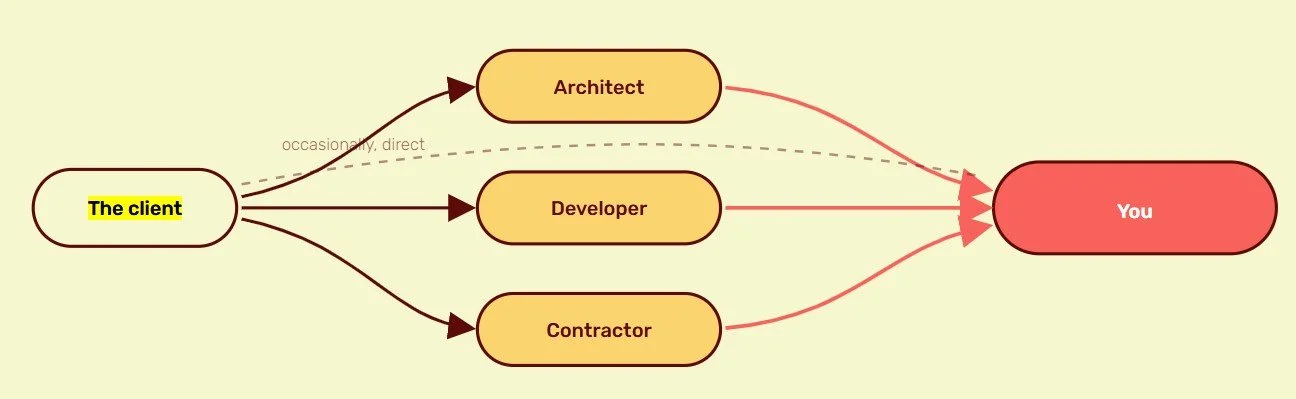
The coral routes are how most landscape work is actually won. The dashed line is the one most business development advice assumes.
What we actually work on
All of it runs through the four stages of the ROOT Method — specifically for practitioners, not adapted from a sales playbook.
Being the name that comes up
When an architect is putting a team together on a Tuesday afternoon, you want to be who they think of. That's built long before the pursuit.
1
The work you actually want
Deciding what kind of projects, sites and clients you want more of — so you stop saying yes to everything that lands.
2
Your real network, mapped
Old classmates, consultants, contractors, former colleagues. It's bigger than you think, and it's currently spread across four inboxes.
3
Reaching out without a pitch
Messages that sound like you and would be fine if forwarded. No scripts, no value proposition, no follow-up cadence.
4
Staying in touch through the long gap
Our timelines run in years. This is how you stay present without becoming the person who only calls when they need something.
5
Doing it in the hours you have
Built for a principal with a full project load — not for someone with a marketing department behind them.
6
Is this for you?
Worth being honest about both sides.
A good fit if…
You're a principal or associate expected to bring work in
You're technically excellent and uneasy about the business side
You'd rather have twenty real relationships than a CRM full of names
You're willing to give it a few months before judging it
Probably not if…
You need three new projects this quarter — relationships don't move that fast
You want scripts and templates to copy
You're looking for lead lists or cold outreach
You don't want to be the one doing it
Other ways to work together
-
The opposite. Small practices are exactly who this is for, because there's nobody else to hand it to. Most of my clients are principals doing this between deadlines.
-
No. This is about fewer, deeper relationships with people whose work you admire — not rooms full of strangers and a stack of cards.
-
No — architects, engineers and contractors too. But it's my own profession, so it's the one where I can be most specific.
Questions Designers ask
-
It changes everything, and it's the main reason generic advice fails us. We focus on the relationships that actually decide whether you're on a team.
-
Association sessions are usually one-off talks. This is ongoing, applied to your own practice, and you have someone checking whether you actually did it.
-
Yes. Coaching and the virtual workshop run online worldwide. In-person work is mostly around Dallas, but I travel.
Not a landscape architect?
The method is the same. The specifics aren't.
Let's talk
A short intro call, no pitch. I'll tell you honestly whether I can help — and if I can't, I'll usually know who can.
Subscribe to our newsletter
Sign up with your email address to stay in the know and to read my thoughts and insights.