
1.1 Coaching
You & me
The ROOT Method applied to your work, your relationships and your goals — with someone in your corner who's done the job, and who'll notice when it quietly slips.

Free · 30 minutes · no pitch
Twelve years designing
then business development at Suffolk, Studio Outside and TBG.
When people usually get in touch
Coaching tends to start at a turning point. Maybe one of these is yours.
“
I just made principal, and suddenly bringing in work is part of the job description.
New role
“
I'm going out on my own and I've never had to find a single client myself.
Starting a practice
“
I keep starting, then a deadline hits and it stops — every single time.
Stalled
“
I'm getting work, but not the work I actually want to be doing.
Wrong work
How the coaching unfolds
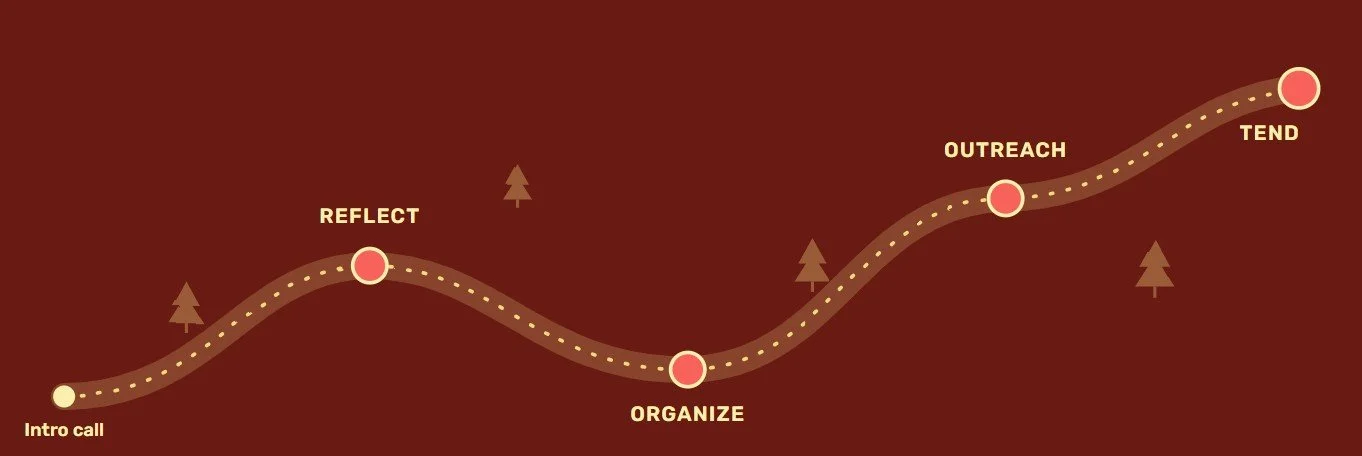
Same four stages as the method, but at your pace and shaped around your situation. Think of it as a trail rather than a syllabus.
First weeks
Reflect
We start with why you do this work and what you want more of — before anyone gets contacted.
Month one–two
Organize
We dream about where your work could go, then cut it down to a simple plan you'll actually follow.
Month two onward
Outreach
You start connecting with people who inspire you, and we work through each conversation together
Ongoing
Tend
We build a rhythm of nurturing and giving that survives your busiest months — the part that brings the work in.
What a session looks like
Every session ends with something you'll actually do — never a long list.
Sessions are online or in person in Dallas, roughly every two weeks. We talk about real people, real projects and real conversations — not hypotheticals.
Between sessions, you can message me when something comes up — an email you're not sure how to write, a meeting you want to prepare for.
Start
Check in
What happened since last time. What worked, what stalled, and why.
Middle
Go deep on one thing
Usually a specific relationship, conversation or decision you're facing right now.
End
Commit to two or three actions
Small enough to fit a busy fortnight. We'll look at how they went next time.
Coaching or the workshop?
Same method, different depth. Here's how to choose.
| 1:1 COACHING | VIRTUAL WORKSHOP | |
|---|---|---|
| Focus | Your situation, specifically | The method, in a group |
| Pace | Set around you, over months | Five weekly sessions |
| Depth | Real conversations, worked through together | All four stages, one pass |
| Accountability | From me, directly | From a cohort of twelve |
| Best for | A turning point, or when you keep stalling | Trying the approach first |
Not sure? Plenty of people start with the workshop and move into coaching afterwards.
What changes
You know what you're after
Clarity about the work you want, so you stop saying yes to everything that lands.
It stops feeling like selling
You reach out as yourself to people you admire, and it feels like a normal part of the job.
It survives a busy month
A rhythm light enough to keep going when a deadline hits — which is when it usually dies.
Is coaching right for you?
A good fit if…
You're responsible for bringing in work and nobody showed you how
You're at a turning point — new role, new practice, new direction
You've tried on your own and it keeps stalling
You're willing to give it a few months
Probably not if…
You need projects this quarter — relationships don't move that fast
You want someone to do the outreach for you
You're looking for scripts or lead lists
You'd rather try the method first — start with the workshop
How to start
No forms to fill in, no sales process.
1.
Book an intro call
Thirty minutes to talk about where you are and what you want. Free.
2.
See if it fits
If I'm the right person, I'll say so and suggest a plan. If I'm not, I'll tell you — and usually point you to who is.
3.
Begin with Reflect
We start where the method starts: with why you do this work.
Questions about coaching
-
To confirm — most people commit to a few months, because that's how long it takes for the Tend stage to start paying off.
-
Either. Online works anywhere; in person is available around Dallas.
-
Yes, and many do — it's professional development. Invoicing details to confirm.
-
To confirm — usually every couple of weeks, which leaves time to actually do things in between.
-
Completely. We'll talk about real people and real firms, and none of it goes anywhere.
-
I came to this from the drawing board, not from sales. The method is built on relationships you're already good at, not techniques borrowed from another profession.
Other ways to work together
Let's see if it fits
Half an hour, no pitch. I'll tell you honestly whether I can help.
Subscribe to our newsletter
Sign up with your email address to stay in the know and to read my thoughts and insights.